
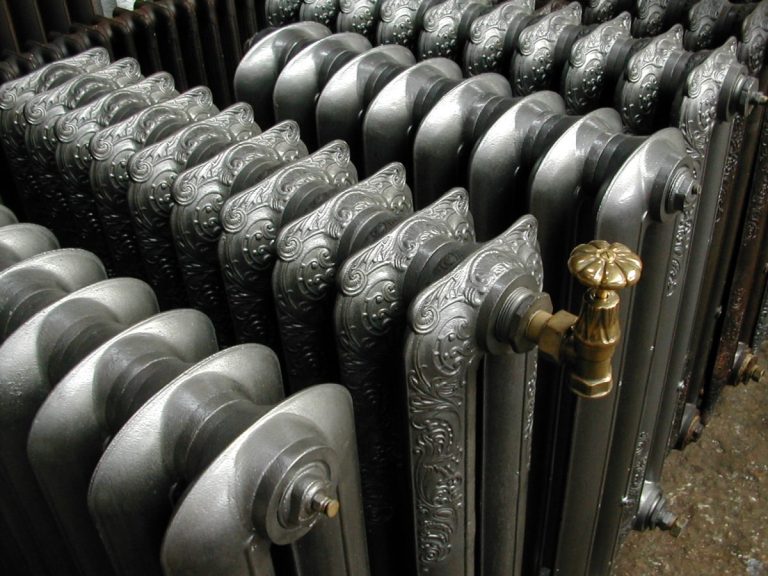
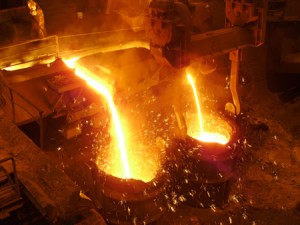
Cast iron is an alloy that is composed mainly of iron, but it also contains 5 % carbon. It can be easily cast and its malleability makes it one of the materials most appreciated by scrap dealers.
Moreover, its flexibility makes it cost significantly more than iron. The castings obtained with cast iron are very compact. Indeed, even though it is bulky, its light weight nonetheless gives it some undeniable advantages. Before we dive into its market and price, down with this metal so necessary to human life.
How to obtain cast iron?
First-melt cast iron is the metal obtained by processing the ore. To obtain it, the said ore must be extracted, crushed and ground, the gangue removed and the pieces recovered to make a compact block.
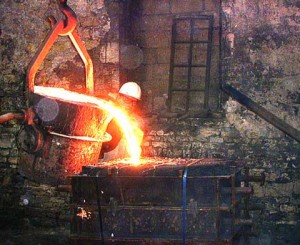
Finally, this ore must be reduced in a blast furnace to
obtain first-melt cast iron. In fact, part of this cast iron will be used for molding cast iron parts.
Cast irons with defined chemical composition can be produced with cupolas and electric furnaces, fixed, arc or induction.
Second-melt cast irons are obtained by a second melting of the remnants from the first metal melt. Refining and dosing are carried out according to the desired grade. Moreover, these remnants are often returned to the foundry so that they hold better.
Synthetic cast irons, for their part, are obtained by melting a charge that allows a chemical synthesis of all the elements that make up the cast iron. Thus, the iron is supplied by ribbons of unalloyed steels, the elements to be introduced are supplied by the corresponding ferroalloys.
Carbon, for its part, is obtained from carburized ferromanganese or graphite.
The structure of cast irons
The structure of a cast iron is close to that of a steel which concentrates a variable carbon content and graphite. For white cast iron (without graphite), solidification and cooling occur according to the metastable iron-cementite diagram. Graphite cast iron, for its part, can appear in various forms, but the percentage of carbon in its composition will only depend on the cooling rate.
 Thus, if the cooling rate is slow, then cooling from the liquid state will occur according to the iron-graphite diagram, which will ultimately give a final ferrite-graphite structure. If the cooling rate is faster, then solidification should begin with the iron-graphite diagram and end with the iron-cementite diagram. This is, moreover, the most complex case that can be found in the matrix. There may also be a ledeburite mixed with phosphorus in the matrix. Finally, if the cooling rate is rapid, then solidification and cooling will follow the iron-cementite diagram. This last case notably makes it possible to obtain ledeburite and ferrite.
It should be noted that several factors influence the cooling rate, such as the density of the part, the mold or the temperature of the cast iron at the time of pouring.
In short, cast iron displays a very complex structure; this is notably why its price is quite high compared to other metals. However, price issues do not take away from its many qualities.